3D printing
InfraTec ImageIR camera monitoring 3D Printing
Thermal Spray
3D printing close up

Ensure Precision, Consistency and Quality Layer by Layer

Additive manufacturing refers to the production of 3D objects through the precise application of material, layer-by-layer. Additive manufacturing as evolved from a tool for testing and prototype development, to a widely-used industrial production technology. Temperature is a key factor in the quality of the final product and must be monitored closely throughout production.

Infrared imaging technology provides powerful, non-contact monitoring and inspection capabilities for additive manufacturing processes. By capturing thermal data in real-time, infrared cameras enable manufacturers to detect irregularities during production, optimizing parameters and ensuring structural integrity of the final product, all without interrupting the production process.

3D printing filament imaged with thermal camera

Key Benefits of Infrared Cameras for Additive Manufacturing

  • Real-time Visibility: Monitor temperature distribution throughout the build to detect issues as they occur.
  • Defect Prevention: Identify thermal anomalies linked to porosity, delamination, or incomplete fusion before they impact part quality.
  • Closed-loop Control: Integrate thermal feedback to automatically adjust printing parameters for consistent results.
  • Non-Destructive Inspection: Detect hidden defects and assess part integrity without interrupting production.
  • Optimized Material Performance: Analyze thermal behavior across layers to improve bonding, microstructure, and surface finish.
  • Higher Efficiency and Yield: Reduce print failures, minimize waste, and achieve repeatable, high-quality output.
  • Compatible Across Processes: Ideal for metal, polymer, and composite additive manufacturing systems.
Thermal camera capture of additive manufacturing

Temperature Monitoring

High-Speed Infrared Cameras, such as the InfraTec ImageIR 9400, enable continuous, real-time monitoring of temperature distribution throughout the additive manufacturing process. 

By visualizing the thermal profile of each layer as it is deposited, operators can detect anomalies such as overheating, incomplete melting, or inconsistent cooling that may lead to defects or dimensional inaccuracies.

Thermal data collected can be used for closed-loop feedback control, allowing process parameters to be automatically adjusted to maintain optimal printing conditions. This leads to less waste and supports the production of high-quality parts with consistent mechanical performance.


Case Study: 3D Printing under the Thermographic Microscope


3D printing thermal image

Material and Layer Analysis

Infrared imaging provides valuable insight into the thermal behavior of materials during additive manufacturing, enabling detailed analysis of each deposited layer. 

By tracking temperature gradients and cooling rates, it helps engineers understand how heat transfer affects layer adhesion, microstructure formation, and residual stress development. Monitoring spray formation in the laser powder fusion process is critical to ensure uniform size and distribution of spray and splatter analysis.

Thermal data can be used to optimize laser power, scanning speed, and layer thickness for different materials, from metals to polymers and composites, ensuring uniform bonding and consistent part performance. 

Through precise material and layer analysis, infrared imaging supports process optimization and the development of more reliable, high-quality additive components.


Article: In-Situ Defect Detection in Laser Powder Bed Fusion by Thermography and  Optical Tomography 

(Featuring InfraTec ImageIR 8300)
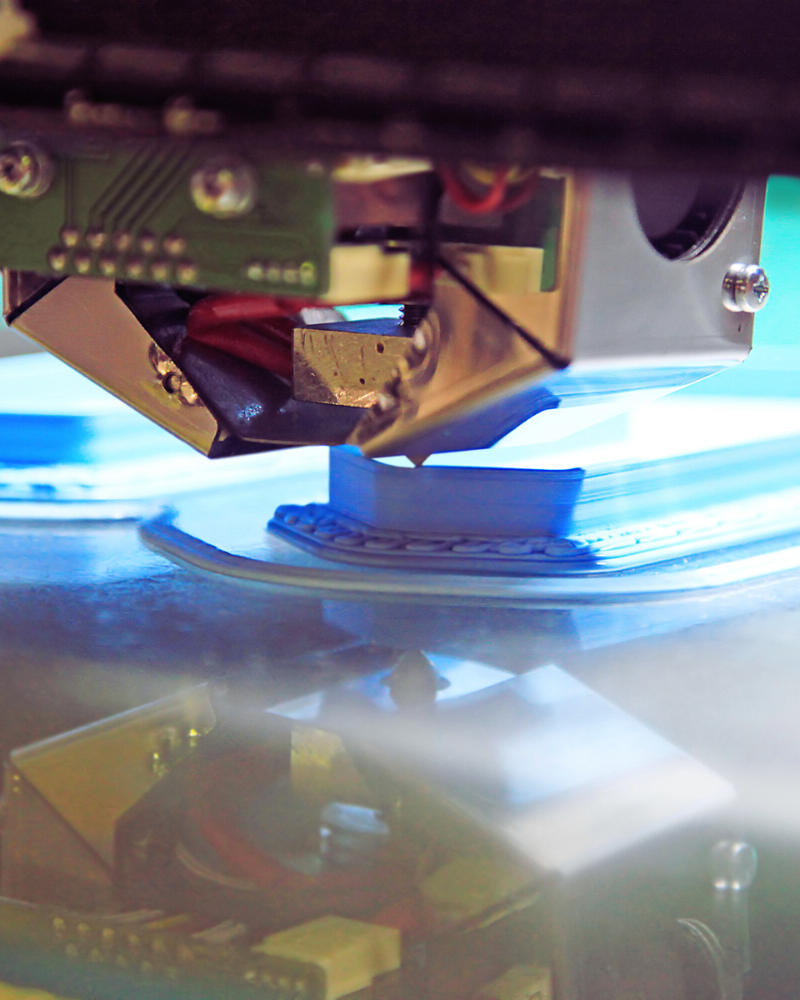
3D printing of parts

Post-Process Inspection

Infrared technology serves as an effective non-destructive evaluation tool for post-process inspection in additive manufacturing. 

By analyzing thermal responses as parts are heated or cooled, it can reveal hidden defects such as cracks, voids, delamination, or areas of poor bonding that are not visible on the surface. 

This allows manufacturers to assess structural integrity and detect residual stresses without sectioning or destroying the part. 

Compared to traditional inspection methods, infrared thermography offers faster, full-field assessment and can be easily integrated into automated inspection workflows, improving efficiency and integrity.


Paper: Influence of Process Conditions on the Local Solidification and Microstructure During Laser Metal Deposition of an Intermetallic TiAI Alloy

(Featuring InfraTec VarioCAM HDx head 600)
